

In-house billing teams offer flexibility, control and direct oversight on billing practices. Yet, with so much hype and apparent benefits, the trade-offs run much deeper than the apparent benefits that are appealing for healthcare providers. A similar case is with the therapeutic modalities offered by practices like physical therapy, chiropractic and behavioral rehabilitation, where simple and small errors cause revenue drain. Every care being offered in therapeutic modalities goes for free when in-house billers fail to capture full charges, where practices get partial payouts or no payments at all.
In this blog, we will delve deep into this critical matter and help you know what are the factors that are mostly overlooked in medical billing and coding, that are leading to a massive revenue drain. When your revenue cycle is streamlined and the billing team stays updated on local coverage determinations, untimed and timed coding standards, the result is complete protection of your profit margins and retroactive clawbacks. We will also explore why outsourcing the time and quality-centric parts of your medical billing can save you from coding traps and billing errors, leading to a healthy ROI.
The Hidden Math of Unbilled Minutes
When your in-house billing team regularly fails to maintain accurate documentation and timed sessions, this leads to snowball effect over time:
The Cost of Lost Time
Small documentation slips where 4-5 minutes of therapeutic modality sessions are misreported to over 15-20 patients daily can make it 100 of hours weekly. Apparently these 4-5 minutes each patient is small but when these are happening in real-time and billers fail to record them, you’re giving these free minutes to patients without charging them.
The 8-Minute Rule Trap
One of the worst consequences is seen in CPT timed coding modality where codes ranging 97010–97039 are misapplied or misreported. Under the Medicare 8-minute rule, practices who fail to accurately aggregate time CPT codes (97032–97039), bill just 1 unit instead of 2, stripping providers of their hard-earned revenue. These missing units are never paid because they are never reported, forcing practices to leave money on the table.
How In-House Billing Friction Drains Clinic Margins
In-house billing and coding teams often find themselves overburdened. They struggle to keep the balance between patient care and billing precision, leading to low productivity:
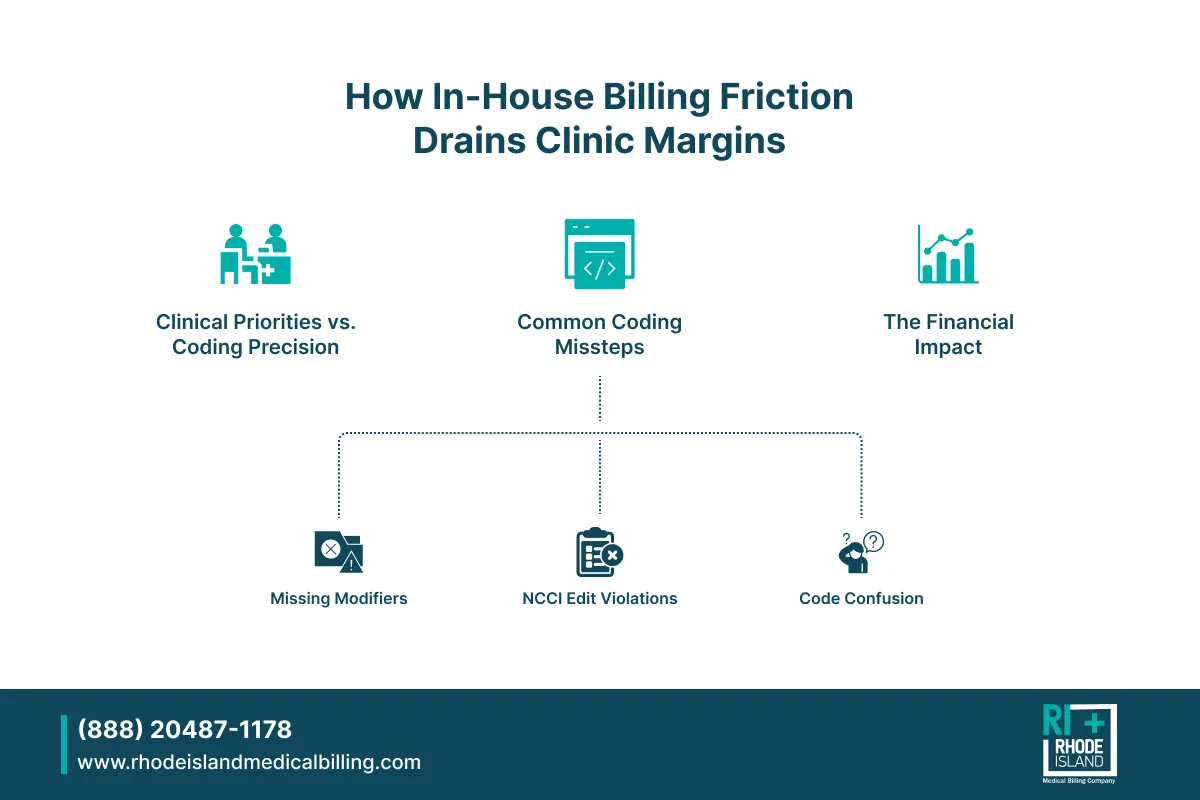
Clinical Priorities vs. Coding Precision
In-house billing staff has a lot on their plate. On one side they are managing patients at the front desk, on the other, they must stay current with the evolving insurance reimbursement guidelines. In this high-stress environment, it’s only human when billing and coding errors seep in and become systemic issues.
Common Coding Missteps
When the healthcare facilities lack medical coding expertise, they constantly make costly errors like:
Missing Modifiers
Many inexperienced coding staff fail to add key modifiers like -59 for distinct procedural services or therapy modifiers like GP, GO and GN, prompting insurance to bundle these services.
NCCI Edit Violations
Separately charging bundled services or improperly bundling results in NCCI violations. Insurance downcode the service and can start audit review for frequent violations.
Code Confusion
Failing to understand the correct application of untimed vs timed modality coding force payers to downcoding, resulting in partial payments.
The Financial Impact
The impact of these small but crucial mistakes deeply impact your revenue by increasing denial rates, days in AR and negatively impact operational efficiency.
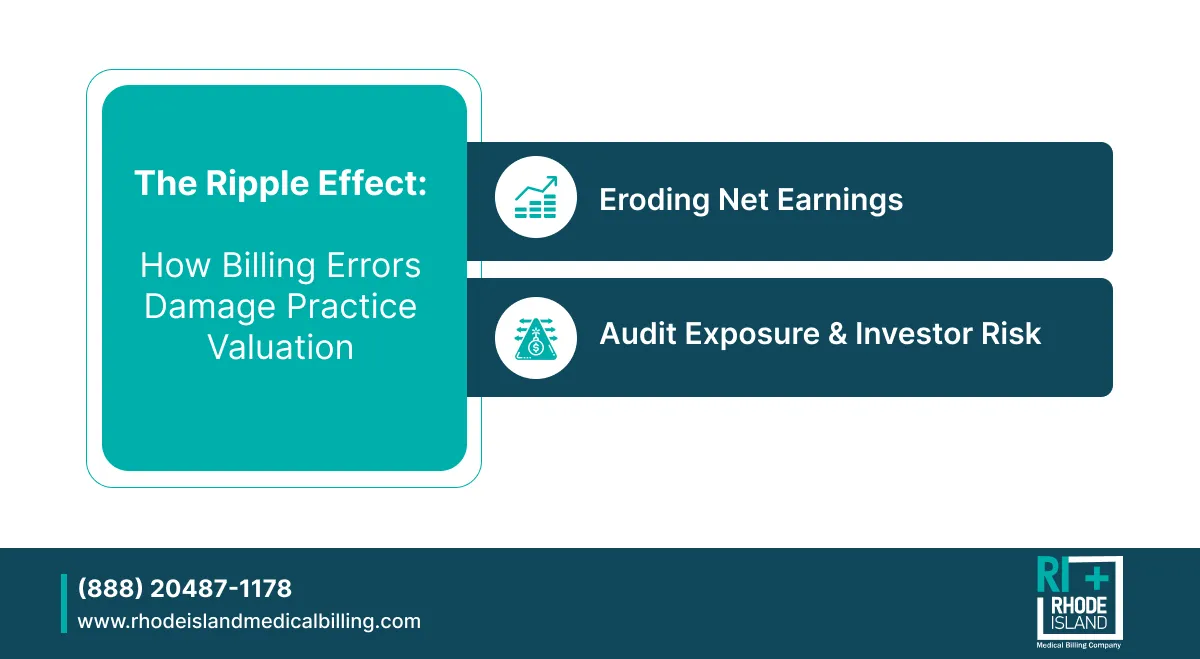
The Ripple Effect: How Billing Errors Damage Practice Valuation
The true cost of therapeutic modalities billing errors extends beyond the day-to-day operation and its results are far greater than cash flow disruption:
Eroding Net Earnings
In modern health care revenue cycle management, your clinic’s valuation and profitability is directly linked with net EBITDA (Earnings Before Interest, Taxes, Depreciation, and Amortization). With higher claim denial rates, aging account receivables and lower earnings per claim, your practice loses market valuation, negatively impacting the financial position of your clinic when seeking loans for expansion, merger or selling.
Audit Exposure & Investor Risk
Medical billing errors in therapeutic modalities expose your practice’s vulnerability, making it easy for payers to initiate audits and clawbacks for erroneous claims. Moreover, non-compliance liabilities like fines and penalties erode investor confidence when you put your practice up for sale, merger or IPO. Thus, small and seemingly harmless billing errors damage your practice’s financial growth and profitability.
The Solution: Transitioning to Specialized Modality RCM
When the in-house billing staff is struggling to manage multiple tasks and systemic billing issues are opening the door for aggressive financial clawbacks, the way forward is transitioning to specialized partnership:
The Value of Specialized Expertise
Outsourcing a dedicated and trained therapeutic modality RCM partner as an extension of your billing team removes reactive and rushed billing submission. Doing this integrates accuracy and compliance directly into systematic oversight, resolving issues appropriately. Choosing an expert therapeutic modality billing partner offers:

Automated Claim Scrubbing
AHIMA & AAPC-certified coders catch coding errors, conflicts, and NCCI edits violations timely, increasing clean claim submission.
Precision Rule Tracking
Outsourced RCM staff help you implement strict 8-minute rule compliance on every timed CPT code, ensuring every minute you spend with the patient is paid for.
Strategic Modifier Application
Trained and skilled therapy modality coders are expert at appending valid and approved modifiers like -59 for distinct procedure services beside therapy modifiers like GP/GO/GN to avoid bundling errors.
Audit-Proof Standards
Outsourced medical billing specialists ensure timely and audit-proof clinical documentation to prevent claim denials and audits.
The Financial Impact
Trusted RCM partners help you convert every lost unit per claim, increasing collection and profitability to financially secure your practice. Providers can easily enhance the valuation and resilience of their practice for the long term.
Key Takeaway
Treating the unpaid care and unbilled units as an afterthought weaken the financial integrity of your practice. Stretching your staff thin with patient care duties beside maintaining the coding compliance, meticulous documentation reduces the efficiency of your revenue cycle operations. Outsourcing dedicated and expert RCM partners for billing therapeutic modalities allows your staff to focus solely on patient care, improving patient trust and experience.
Instead of relying on outdated business methodologies on running everything in-house, outsourcing is considered as the best and most viable solution for busy practices. Doing this improves clinical outcomes and financial prospects for future merger, acquisition, and expansion.
Is your practice suffering from underbilling and compliance issues? Resolve your revenue cycle problems with dedicated billing staff that will help you charge patients accurately without missing a single therapy unit. Contact Rhode Island Medical Billing today and get tailored solutions for your practice.