
Accurate diagnosis coding is an important part of behavioral health billing. Eating disorders can also involves the several distinct diagnoses, and the correct ICD 10 code for an eating disorder depends on a condition documented by the healthcare provider. Using an outdated, overly broad, or unsupported code can also create problems during the claim submission and may be contribute to the denials or payment delays.
There are several eating/feeding disorder diagnoses in the ICD-10-CM F50 category. Existing ICD coding provides increased detail for some eating and feeding disorders like anorexia nervosa, bulimia nervosa, and binge eating disorder, along with a severity and remission option for certain diagnoses.
For general clinical and patient education information, providers can also refer to MedlinePlus eating disorder resources, which provides information and links to federal health resources related to eating disorders.
For behavioral health practices, eating disorder coding should include the provider assessment and clinical documentation, diagnosis code, procedure code, as well as the claim information. This tutorial will demonstrate you how to choose the correct code and prevent common eating disorder billing errors.
What Is the ICD 10 Code for Eating Disorders?
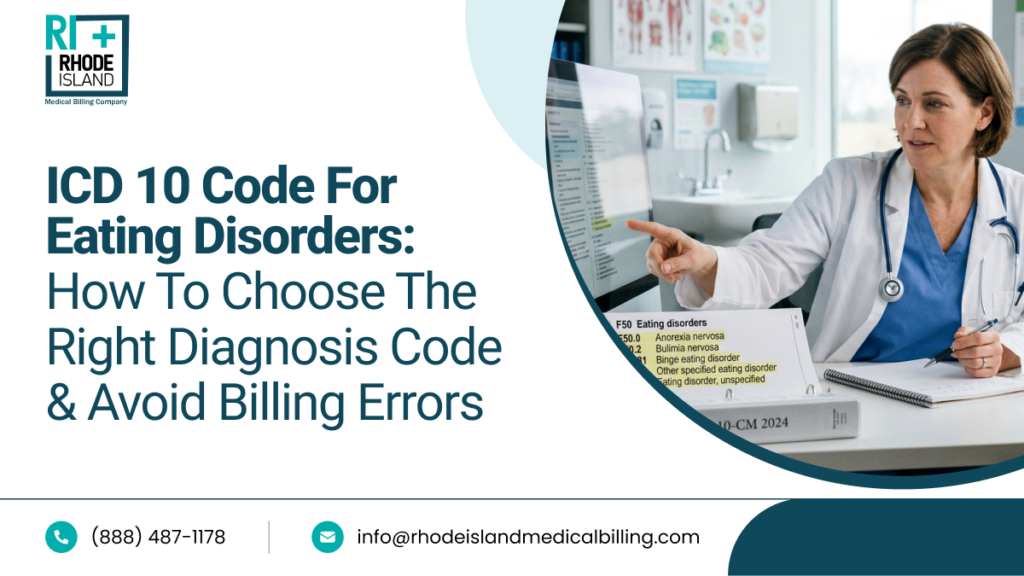
All Patients Don’t Have the Same ICD 10 Code for Eating Disorder. There is an F50 category for eating disorders within ICD-10-CM and the appropriate code is determined by the diagnosis documented in the patient record.
Providers should always verify the applicable code and coding guidelines in the current CMS ICD-10 code files before submitting claims.
These are the 8 most common diagnoses we will see in our practice. Anorexia nervosa Bulimia nervosa Binge eating disorder Avoidant/restrictive food intake disorder (ARFID) Pica in adults Rumination disorder in adults Other specified feeding or eating disorder Eating disorder unspecified.
Top Coding Rule: The diagnosis reported on the claim must be the same as the provider’s, following ICD-10-CM coding rules.
Common ICD 10 Codes for Eating Disorders
Below is a table of the most frequently used ICD-10-CM current codes in the F50 classification group.
| Eating Disorder | ICD-10-CM Code | Coding Description |
| Anorexia nervosa, unspecified | F50.00 | Anorexia nervosa without documented type or additional specificity |
| Anorexia nervosa, restricting type | F50.010–F50.019 | Codes distinguish severity, remission, or unspecified severity |
| Anorexia nervosa, binge eating/purging type | F50.020–F50.029 | Codes distinguish severity, remission, or unspecified severity |
| Bulimia nervosa | F50.20–F50.25 | Codes distinguish unspecified, mild, moderate, severe, extreme, and remission |
| Binge eating disorder | F50.810–F50.819 | Codes distinguish severity, remission, or unspecified severity |
| Avoidant/restrictive food intake disorder | F50.82 | Specific ARFID diagnosis |
| Pica in adults | F50.83 | Adult pica |
| Rumination disorder in adults | F50.84 | Adult rumination disorder |
| Other specified eating disorder | F50.89 | Other specified eating disorder |
| Eating disorder, unspecified | F50.9 | Eating disorder without sufficient specificity for another applicable diagnosis |
This information is for newer DSM codes such as F50.010 through F50.019 (narrow or restricting-type anorexia); F50.020 through F50.029 (binge eating/purging-type anorexia); F50.20 through F50.25 (bulimia nervosa); and F50.810 through F50.819 (binge eating disorder).
Note that there are separate codes for pica in childhood and for rumination disorders (F98.3 and F98.21). Coders should not automatically assign adult F50 codes for pediatric cases.
How to Choose the Right Eating Disorder Diagnosis Code
The first step in selecting an eating disorder ICD 10 code is to work from the noted diagnosis of the provider and not just the patient’s symptoms.
A practical coding workflow includes the following steps:
1. Review the Provider’s Diagnosis
Start with the assessment and diagnosis documented by the qualified healthcare provider. There is no way for a coder to come to the conclusion of an eating disorder based on the symptoms written down in the record.
For instance, documentation might include: Anorexia nervosa Binge eating disorder Bulimia nervosa ARFID Other specified eating or feeding disorder (e.g., avoidant restrictive food intake disorder – ARFID). The selected code should correspond to that documented diagnosis.
2. Determine Whether the Diagnosis Has Additional Specificity
Additional specificity is available for some eating disorder codes. For instance, the current ICD-10-CM codes specify between restricting-type and binge eating/purging-type anorexia nervosa and specify severity and remission.
When the provider has entered information that would lead to a more specific code, the coding team would then reference the relevant set of codes and not choose an unspecified diagnosis.
3. Check the Current ICD-10-CM Code Set
Eating disorder codes have changed over time. Several older broad codes were replaced by more specific codes beginning with the 2024 code updates. CMS documentation specifically identifies deleted and newly added eating disorder codes.
This makes annual code-set review important for practices handling eating disorder claims.
4. Match the Code to the Documentation
The diagnosis code should accurately reflect what is documented in the patient’s record.
If the medical record does not support severity, remission, type, or another required distinction, the coder should not assume that information.
5. Review Coding Instructions
Prior to submitting a claim, the coder should review the appropriate ICD-10-CM guidelines, Instructions in the Tabular List, Excludes notes, and payer instructions.
Professional medical coding services can aid practices in ensuring consistency in their coding of diagnoses and claim submissions in the absence of in-house expertise.
Eating Disorder Documentation Requirements
Proper care planning documentation is also important for communication about the eating disorder and billing for services. The record should include the diagnosis as well as support for the provided services.
Depending on the clinical situation, documentation may include:
- Confirmed diagnosis
- Clinical assessment and findings
- Relevant symptoms and behaviors
- Diagnosis type or subtype
- Severity when applicable
- Remission status when applicable
- Relevant medical and psychiatric history
- Treatment goals
- Treatment plan
- Patient response to treatment
- Medical necessity
- Progress and changes in the condition
Documentation should also remain consistent across the clinical record and claim.
For example, when the provider specifies a type or severity of anorexia nervosa and the claim specifies a different diagnosis, or an unspecified diagnosis not meaning to match the one on the claim, this can raise flags.
Specific vs. Unspecified Eating Disorder Codes
A prevalent coding error for eating disorder diagnoses is the use of an unspecified code when the documentation in the medical record substantiates a specific diagnosis.
F50.9-for instance, eating disorder, unspecified-may be suitable if the provider identified an eating disorder but information is insufficient to further specify it.
But omission of coding cannot just be the standard assumption for an eating disorder claim.
The above idea is also true for diagnoses that contain more than one level of clarity. ICD-10-CM codes currently exist that represent all types, and degrees of severity for: anorexia nervosa; bulimia nervosa; and binge eating disorder.
The coding staff should select the most specific code supported by the provider documentation and the current coding rules.
ICD-10-CM and CPT Codes: What Is the Difference?
An important part of eating disorder billing is understanding that ICD-10-CM and CPT codes serve different purposes.
ICD-10-CM codes describe the diagnosis or reason for care.
CPT codes generally describe the professional service performed.
For example, if a behavioral health provider diagnosed an eating disorder, he or she could list the diagnosis plus the psychotherapy, evaluation, or other service code listed for the treatment that was provided.
The diagnosis must justify medical necessity for the service, but the assignment of an ICD-10-CM diagnosis code does not in and of itself secure reimbursement for the service.
Practices should also determine payor-specific requirements pre-authorization for behavioral health claims.
Eating Disorder Billing Workflow
Getting the right diagnosis is only one step in the revenue cycle. To optimize revenue, eating disorder billing should include everything from front-end insurance verifications to coding, claims, payment posting, and follow-up.
Verify Insurance Benefits
Prior to treatment, the billing team should check coverage including behavioral health benefits, network, deductible, coition, limitations, referrals, and authorizations, if necessary.
For more information, see the live guide on VOB in Medical Billing, which explains how verification of benefits can identify coverage and authorization issues before claims are submitted.
Review Documentation and Codes
Before claim submission, billing and coding teams should verify that the diagnosis code matches the provider’s documentation and that the procedure code represents the service actually performed.
Submit Clean Claims
Claims should contain accurate patient, provider, insurance, diagnosis, procedure, authorization, and other required information.
Monitor Claim Adjudication
After submission, the billing team should monitor whether the claim is accepted, rejected, denied, or paid.
Follow Up on Unpaid Claims
Check all unpaid or underpaid claims at once: time spent on all uncollectible claims and the re-billing process is much more.
Those seeking more comprehensive medical billing services practices may choose professional billing assistance for the submission of claims, coding, collections, and the administration of other revenue cycle functions.
Common Eating Disorder Coding and Billing Errors
Even when a diagnosis is clinically appropriate, errors in coding or billing can interfere with claim processing.
Using an Outdated ICD-10-CM Code
Eating disorder coding has become more specific in recent code sets. Continuing to use deleted or replaced codes can create claim problems. CMS identifies several eating disorder codes that were deleted and replaced with more detailed options beginning with the 2024 update.
Choosing an Unspecified Code Automatically
F50.9 can be appropriate in some circumstances, but it must not replace the more specific diagnosis when provider’s documentation supports the one.
Coding From Symptoms Instead of the Diagnosis
A symptom or patient-reported concern should not automatically be treated as a confirmed eating disorder diagnosis.
Coding should follow the provider’s documented assessment and applicable coding rules.
Documentation Does Not Support the Code
If claim reports the diagnosis that is not a supported by a medical record, the payer may be request an additional information or deny claim.
Diagnosis and Procedure Codes Do Not Align
The diagnosis should reasonably support the medical necessity of the service reported. A mismatch between diagnosis, procedure, documentation, and treatment can create billing issues.
Ignoring Payer Requirements
Insurance companies may have specific requirements for behavioral health services, authorization, documentation, claim submission, and coverage. Accurate ICD-10-CM coding alone does not guarantee payment.
How Accurate Coding Can Help Reduce Billing Problems
Eating disorder coding and billing accuracy is a matter of controls at every stage of the revenue cycle, not a final claim audit.
Practices can strengthen their workflow by:
- Keeping ICD-10-CM code references current
- Reviewing provider documentation before claim submission
- Using specific diagnoses when supported
- Avoiding unsupported assumptions
- Verifying insurance benefits
- Tracking authorization requirements
- Matching CPT codes to services performed
- Scrubbing claims before submission
- Monitoring denial patterns
- Following up on unpaid claims
- Reviewing payer-specific policies
These steps can help identify preventable problems before they become repeated claim issues.
The Rhode Island Medical Billing site also maintains coding-focused educational content, including its guide to ICD-10 for Speech Delay, which demonstrates the same principle of matching a specific diagnosis to the provider’s documented findings.
When Practices May Need Medical Billing Support
Eating disorder practices commonly process clinical documentation, patient care, insurance, coding, claims, and follow-up simultaneously. By isolating the clinical billing from revenue cycle operations, a practice can have a more efficient billing process.
A professional billing team may assist with:
- Insurance eligibility verification
- Medical coding
- Claim submission
- Claim status follow-up
- Denial management
- Payment posting
- Accounts receivable follow-up
- Patient billing
- Revenue cycle reporting
Rhode Island Medical Billing provides billing and coding services and lists behavioral health among the specialties supported by its coding team.
Practices can also review the company’s medical billing specialties to see the range of specialty-focused billing solutions available.
Final Takeaway
For the eating disorder ICD 10 code diagnosis entered by provider will be used, and the specificity of a coding will depend on a specificity of the information found in a medical record. Type of the Eating Disorder Now Diagnosed in the ICD-10-CM The ICD-10-CM diagnosis codes for the type of eating disorder now coded in the ICD-10-CM are Anorexia nervosa, Bulimia nervosa, Binge eating disorder, ARFID, Pica of adults, Rumination disorder of adults, Other specified eating disorder and Unspecified eating disorder.
Prevent billing errors Not only the select the correct diagnosis code by itself will prevent billing errors. Corresponding documentation to the new ICD-10-CM codes, the correct procedure codes, insurance verification, authorization, clean claim submission, and time-critical follow-up are a must.
In addition, for practices that need greater revenue cycle support, Top Rhode Island Medical Billing Company also provides a broad spectrum of revenue cycle support like medical billing and coding, accounts receivables, credentialing, eligibility check, and more.
Frequently Asked Questions
What is the ICD-10 code for eating disorders?
There is not a single ICD-10-CM code that is covers every eating disorder. Common codes in the F50 category include codes for the anorexia nervosa, bulimia nervosa, binge eating disorder, ARFID, other specified eating disorders, and unspecified eating disorders.
What is the ICD-10-CM code for binge eating disorder?
Binge eating disorder is coded from F50.810–F50.819, depending on the documented severity, remission status, or whether the severity is unspecified.
What is the ICD-10-CM code for bulimia nervosa?
Bulimia nervosa is reported with F50.20–F50.25. The specific code depends on the documented severity, remission status, or other applicable diagnosis details.
What is the ICD-10 code for ARFID?
Avoidant/restrictive food intake disorder (ARFID) is coded as F50.82 under the current ICD-10-CM code set.
Does an eating disorder diagnosis guarantee insurance reimbursement?
No. An ICD-10-CM diagnosis code identifies the condition reported on a claim, but it does not guarantee payment. Reimbursement can depend on the patient’s benefits, payer requirements, medical necessity, authorization, provider participation, documentation, procedure codes, and other claim-processing rules.
How can eating disorder practices reduce billing errors?
Practices can reduce avoidable billing issues by using the correct ICD-10-CM codes, matching diagnoses to provider documentation, verifying insurance benefits and authorization requirements, reviewing claims before submission, and tracking denials and unpaid accounts for timely follow-up.