
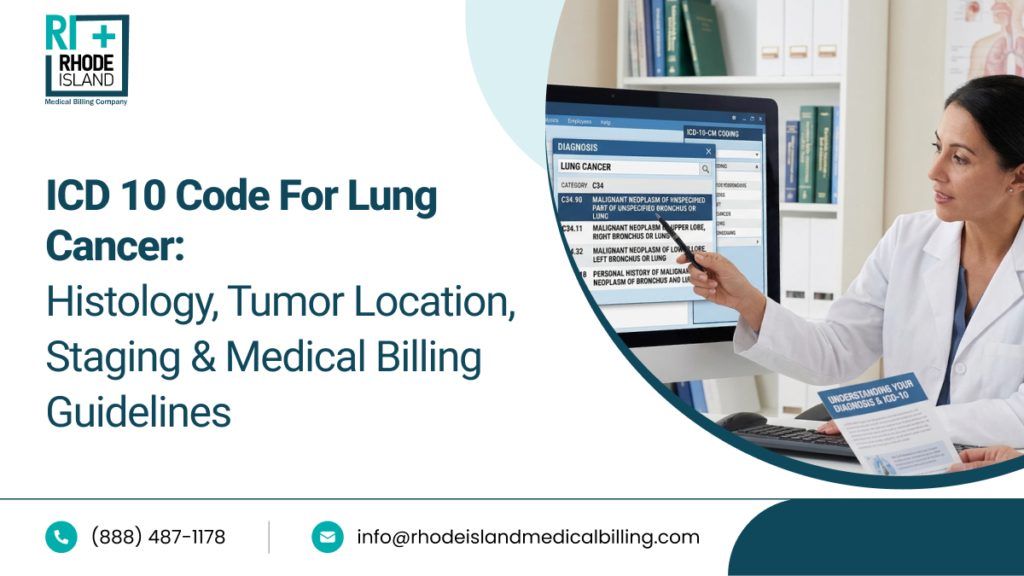
The coding of lung cancer needs to be done carefully. It is essential to ensure the right diagnosis is coded using the ICD-10-CM system so that medical staff can keep medical records up to date. This will assist with insurance claims and avoid unnecessary mistakes with billing.
When coding lung cancer, the ICD 10 code can differ between oncologists, pulmonologists and coders. It will depend on different aspects like which area of the bronchus or lung is affected, where the cancer is affecting the body (laterality) and whether the cancer is primary or secondary.
Histology and staging will play an important role when documenting lung cancer. Whilst they aren’t directly relevant to all ICD-10-CM codes, they can assist with diagnosing the cancer.
Below we have explained the ICD-10 codes for lung cancer, primary and secondary cancers and what needs to be documented. We’ve also included some practical medical coding tips for oncology.
For additional clinical background, healthcare providers can review the National Cancer Institute’s lung cancer types and treatment information to learn more about the disease and its different forms.
Understanding ICD-10-CM Classification for Lung Cancer
The ICD-10-CM classification allows for malignant neoplasms to be coded. Most primary malignant neoplasms of the bronchus and lung would fall under category C34.-. Whereas secondary malignant neoplasms affecting the lungs would fall under category C78.0-.
This is important to know as if the cancer is primary, or secondary.
Start With the Correct Cancer Classification
Before selecting a diagnosis code, establish whether the documented malignancy originated in the lung or spread there from another primary site.
Primary Malignancy
Used for malignant neoplasms of the bronchus and lung. The documented anatomical site helps determine the specific code.
Secondary Lung Malignancy
Used for secondary malignant neoplasms involving the lung. Confirm the documented metastatic diagnosis and applicable code detail.
For example, if patients are diagnosed with a primary malignant tumor in the right upper lobe of their lung, they would need a code from C34.1-. If patients were diagnosed with secondary cancer from breast cancer spreading to their lungs, they would need a code from C78.0-. This is to document the secondary malignant neoplasm of the lungs. Patients would also need coding for their primary cancer.
It is important for coders to look at the documentation from the provider including their findings, pathology results, imaging and any other relevant documentation. If there is no documentation to confirm a primary cancer or if it is metastatic, coders shouldn’t assume based on the imaging.
ICD 10 Code for Lung Cancer by Tumor Location
One of the most important factors when coding for a primary diagnosis of lung cancer is to look at the site of the cancer. There are specific codes for different lobes of the lung, main bronchi, overlapping sites of the lung and unspecified. Some common ones include:
Common Primary Lung Cancer ICD-10 Codes
| ICD-10-CM Code | Description |
| C34.00 | Malignant neoplasm of unspecified main bronchus |
| C34.01 | Malignant neoplasm of right main bronchus |
| C34.02 | Malignant neoplasm of left main bronchus |
| C34.10 | Malignant neoplasm of upper lobe, unspecified bronchus or lung |
| C34.11 | Malignant neoplasm of upper lobe, right bronchus or lung |
| C34.12 | Malignant neoplasm of upper lobe, left bronchus or lung |
| C34.2 | Malignant neoplasm of middle lobe, bronchus or lung |
| C34.30 | Malignant neoplasm of lower lobe, unspecified bronchus or lung |
| C34.31 | Malignant neoplasm of lower lobe, right bronchus or lung |
| C34.32 | Malignant neoplasm of lower lobe, left bronchus or lung |
| C34.80 | Malignant neoplasm of overlapping sites of unspecified bronchus and lung |
| C34.81 | Malignant neoplasm of overlapping sites of right bronchus and lung |
| C34.82 | Malignant neoplasm of overlapping sites of left bronchus and lung |
| C34.90 | Malignant neoplasm of unspecified part of unspecified bronchus or lung |
| C34.91 | Malignant neoplasm of unspecified part of right bronchus or lung |
| C34.92 | Malignant neoplasm of unspecified part of left bronchus or lung |
As you can see this shows how specific you need to be when coding. You need to know the full code, description and any requirements for that year.
Location Makes a Difference
Use the documented tumor location and laterality to identify the appropriate primary lung malignancy code.
Main Bronchus
Right: C34.01
Left: C34.02
Upper Lobe
Right: C34.11
Left: C34.12
Lower Lobe
Right: C34.31
Left: C34.32
Unspecified Part
Right: C34.91
Left: C34.92
How Laterality and Location Affect Code Selection
If a patient is documented with a primary malignant neoplasm in the left upper lobe of their lung, they would need C34.12. As it specifies the upper lobe and left of the lung.
If the provider has documented that a patient has a malignancy in the right lung but haven’t specified which area of the lung is affected then C34.91 could be used.
Do not use a non-specific code to save time. Always look at the documentation in the medical record to ensure you are coding to the most specific level.
Five Details to Review Before Coding
Tumor Site
Identify the documented lobe, bronchus, or other specified location.
Laterality
Distinguish right, left, and unspecified anatomical details where applicable.
Primary or Secondary
Establish whether the lung is the primary site or contains metastatic disease.
Histology
Review pathology as clinical context, without substituting it for coding rules.
Cancer Stage
Use staging as supporting clinical information, not as a substitute for diagnosis coding.
When the record lacks essential specificity or contains conflicting details, seek clarification rather than making assumptions. Follow the current ICD-10-CM Alphabetic Index, Tabular List, and applicable official guidelines.
Overlapping site codes should be treated with caution. These are used when a tumor affects more than one site. However, the origin of the tumor can’t be identified based on the rules of the classification. Don’t use these just because the tumor is large or affecting multiple areas.
Primary Lung Cancer vs. Secondary Lung Malignancy
One of the most important things to consider when coding a diagnosis of lung cancer is whether the cancer is primary or secondary.
Primary Lung Cancer: C34.-
C34 will be used for malignant neoplasms of the bronchus and lung. Depending on the site and laterality, the right code will be used.
Primary lung cancers can affect the lung in many ways depending on the histology. Non-small cell lung cancer, small cell lung cancer etc. Whilst histology will help with classifying the disease, coders should follow the ICD-10-CM index and tabular list. Not assume that each histology has its own code within C34.
Secondary Malignant Neoplasm of Lung: C78.0-
If the cancer has spread to the lungs from another primary site, then the secondary malignant neoplasm category would usually be C78.0-.
| ICD-10-CM Code | Description |
| C78.00 | Secondary malignant neoplasm of unspecified lung |
| C78.01 | Secondary malignant neoplasm of right lung |
| C78.02 | Secondary malignant neoplasm of left lung |
If they have a main malignant tumor in the colon or rectum that has spread to their lungs they need to be coded
Appropriate coding depending on the situation, treatment and guidelines. Never use a code for secondary lung cancer if there is a known diagnosis for the primary site and vice versa.
How Histology and Cancer Staging Influence Documentation
Histology and staging will give important information about the cancer. However, they don’t relate directly to the anatomical classification.
Histology: Identifying the Cancer Type
Histology will tell you what type of cancer has been identified. Common types of lung cancer include:
- Non-small cell lung cancer (NSCLC): A broad group that includes adenocarcinoma, squamous cell carcinoma, and other types.
- Small cell lung cancer (SCLC): A distinct type of lung cancer with different clinical characteristics and treatment considerations.
- Other specified malignancies: Additional tumor types that require review of the pathology report and applicable coding guidance.
In some cases, there might be a clue in the pathology report pointing towards the diagnosis. But you are not going to use that. Use what the provider has documented for the diagnosis and the coding rules.
Accurate documentation should reflect the provider’s confirmed diagnosis and the extent of the disease. For additional background, review the National Cancer Institute’s guidance on cancer diagnosis and staging.
Staging: Understanding Disease Extent
Staging will tell you how far the cancer has spread. Lung cancer often uses the TNM staging system. This looks at the primary tumor, regional lymph nodes and distant metastases.
Staging can give an indication of how far the malignancy has spread but will not have any impact on the diagnosis code.
Always use the documented rules for coding the diagnosis. Do not assume that if it is a certain stage then it will be a secondary malignant neoplasm. Don’t assume that just because it is a higher stage it will have metastasized to a certain organ.
Documentation Requirements for Accurate Lung Cancer Coding
Accurate documentation will help coders identify the correct diagnosis. This will help payers with evaluating claims. For practices coordinating cancer-related care alongside other complex medical conditions, internal medicine billing services can support accurate billing across a broader range of patient encounters.
Oncology practices should ensure that they have documentation to support the diagnosis, treatment and services provided.
Essential Documentation Elements
Depending on the circumstances, documentation may include:
- Confirmed diagnosis and primary tumor site.
- Laterality and affected lung lobe, when documented.
- Histological type and relevant pathology findings.
- Evidence of secondary malignancies and their documented sites.
- Cancer stage, when available and relevant to care.
- Current treatment plan and the reason for the encounter.
- Relevant imaging, laboratory, and specialist findings.
- Documentation of active malignancy, remission, or personal history when applicable.
- Details supporting the medical necessity of billed services.
The documentation should reflect the current situation of the patient. For example, if they’re receiving active treatment for cancer, undergoing surveillance or have a personal history of malignancy, this can impact the coding.
Active Cancer vs. Personal History
It is a common coding problem in patients who have completed treatment for a previous malignancy.
If the patient’s primary malignancy has been completely eradicated with no further treatment to the area and there is no evidence of malignancy present in the record, it may be appropriate to apply a history code.
However, if there is evidence of current disease or treatment to the primary site then applying a current malignancy code would be appropriate. Make sure that the correct codes are being used in line with clinical situation.
If you do not know whether the cancer is active, ask the coding team for clarification.
Common Lung Cancer Coding Errors and Their Billing Impact
If a claim is not reflective of the documented diagnosis, even if there was a clinically appropriate service provided, you can run into issues.
Using an Unspecified Code Despite Available Details
The record may state which lobe and side of the lung the cancer has affected but the claim is coded as unspecified.
To prevent this, ensure you review the full record and apply the most specific code.
Confusing Primary and Metastatic Cancer
Using C34.- to report a recorded secondary malignancy in the lungs or C78.0- without evidence of metastasis can cause confusion.
To prevent this, confirm what the primary site of the cancer is and ensure there is no evidence of secondary malignancy.
Relying on Histology or Stage Alone
This doesn’t mean you shouldn’t take into consideration the histology and staging, just that you need to ensure you know what the diagnosis was and where it was in the body.
To prevent this, ensure you review the pathology and staging information along with the provider notes and official coding classification.
Incomplete Documentation
If there is no lateralization, uncertainty about the status of the cancer or conflicting information about the diagnosis it can cause confusion around coding. To prevent this, implement a system for asking questions about the documentation and quality assurance.
Inconsistent Claim Information
Confusion can occur when there are discrepancies between the diagnosis and the medical records. To avoid this ensure you do a check before submitting.
By putting systems in place to help reduce errors. This could include regular auditing of coding and using medical coding services.
Learn more about the importance of accurate medical coding and how coding accuracy supports reliable claim submission and reimbursement.
For more information, please read our article on why accurate medical coding is important.
Medical Billing Guidelines for Oncology Practices
Whilst accurate coding using ICD-10-CM is an important step in the revenue cycle for oncology practices, there is more to consider. You need to ensure you are checking insurance eligibility, authorization and submitting claims. Once submitted, you also need to ensure you are posting payments.
Build a More Reliable Billing Process
A structured review helps billing teams connect documented care, payer requirements, and claim follow-up.
Before the Visit
Confirm eligibility, applicable benefits, referral needs, and prior authorization.
During Claim Preparation
Compare diagnosis codes with provider documentation and verify required claim details.
After Submission
Review acknowledgments, payment records, rejections, and denial explanations.
Ongoing Improvement
Identify recurring errors, track outstanding balances, and improve review procedures.
Does the diagnosis match the record? Are coverage and authorization requirements met? Is the claim complete, and is someone responsible for follow-up?
A consistent process can reduce preventable billing problems, but payment depends on coverage, documentation, coding rules, and payer decisions.
Verify Coverage and Authorization
Be sure to verify with the patient’s insurance that they are covered for the service you are providing. You may need to obtain authorization from them before using any services. This will vary depending on the payer, type of service and treatment.
Keeping records of the authorization will help to prevent any unnecessary billing issues.
Review Claims Before Submission
Ensure that the diagnosis has been correctly recorded in the clinical record, there is enough information to make a claim and that all the rules are met.
This can help to highlight any missing information in complex oncology cases. Healthcare organizations managing oncology services across inpatient and outpatient settings can also review our hospital billing services for support with claims, coding, and denial follow-up.
Monitor Denials and Outstanding Claims
Track denied claims, the reason for denial by the payer, claims filing deadline, and if the appeal is necessary. Research any trends you find to see if there may be a problem with your coding, eligibility, authorization, or documentation.
This will help to provide a structured method of following up on claims. This can help your practice identify underpayments. For a better understanding of how payers review claims and determine payment outcomes, read our guide to adjudication in medical billing.
For more information, please read our article on how to reduce claim denials with medical coding.
How Oncology Medical Billing Services Can Help
Due to complex diagnoses, multiple stages of treatment and detailed documentation requirements, oncology practices can benefit from professional medical billing services. Rhode Island Medical Billing can provide the following services:
- Medical coding services: Reviewing diagnosis codes against clinical documentation and applicable coding rules.
- Claims submission: Preparing and submitting claims with the required information.
- Insurance eligibility verification: Checking coverage and benefits before services are provided.
- Denial management: Investigating claim denials and coordinating appropriate corrections or appeals.
- Accounts receivable management: Following up on outstanding claims and unresolved payments.
- Medical credentialing: Supporting provider enrollment and participation processes.
Oncology practices can also explore our medical credentialing services to support provider enrollment and participation with insurance payers.
If you’re looking for cancer billing services, oncology coding support or external revenue cycle support, ensure your practice has systems in place that focus on accuracy, following payer rules and clear communication.
Explore our medical billing services to learn how billing and revenue cycle support can fit your practice’s needs.
Final Thoughts
Accurate coding of lung cancer under ICD 10 will depend on knowing if it is primary or secondary, where it is located, whether it is unilateral or bilateral and what type of histology and staging.
Having thorough documentation and checks in place before submission can help reduce coding errors in an oncology practice, and therefore answer any queries from payers.
Rhode Island Medical Billing can help oncology practices manage medical coding, claim submission, denial follow-up, and revenue cycle activities. If you’re looking for a top medical billing company in Rhode Island, contact our team to discuss billing support tailored to your practice’s needs.
Frequently Asked Questions
What is the ICD 10 code for Lung Cancer?
There is no one code for all lung cancers. Generally, the primary malignancy will fall under the category C34.-. The exact code will depend on what was documented and the laterality. Secondary malignancies in the lungs will generally fall under the category C78.0-.
What is the ICD 10 code for Right Lung Cancer?
The code will depend on what area of the right lung has been affected. For example C34.11 (Primary malignancy of the right upper lobe), C34.31 (Primary malignancy of the right lower lobe) and C34.91 (Unspecified part of the right bronchus and lung).
What is the ICD 10 code for Left Lung Cancer?
The code will depend on what area of the left lung has been affected. C34.12 (Primary malignancy of left upper lobe), C34.32 (Primary malignancy of left lower lobe) and C34.92 (Unspecified part of left bronchus and lung). Select the code that best fits the documentation.
Are metastatic lung cancers coded differently to primary lung cancers?
Yes! Primary malignancies in the lungs will generally fall under the category C34.- and secondary malignant neoplasm will generally fall under category C78.0-. Ensure you are applying the correct codes based on the documentation and situation.
Does the staging affect the ICD-10-CM code?
No! Whilst staging will give information about how far the disease has spread, you must ensure that the code reflects the documented malignancy and rules.