
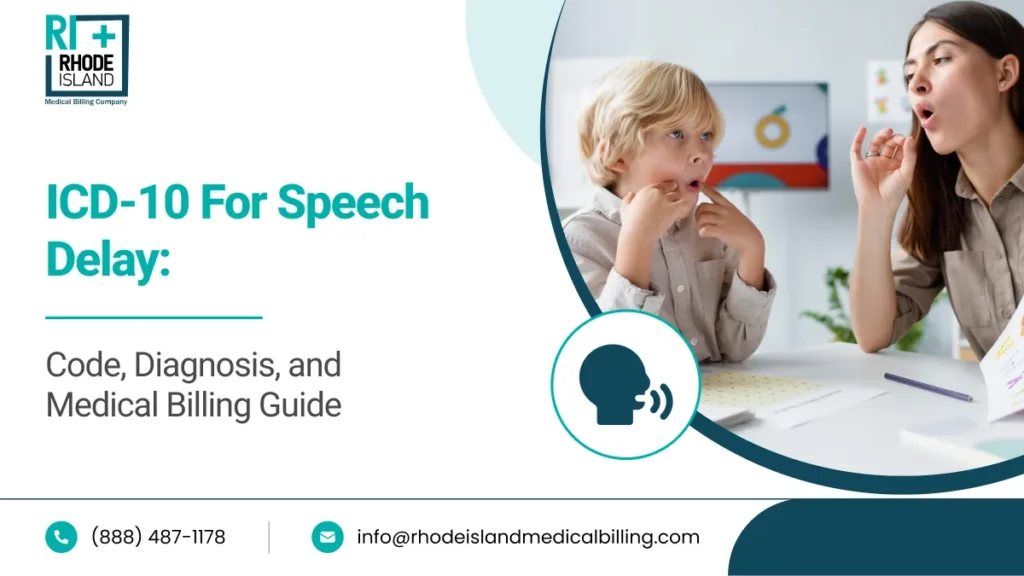
The correct ICD 10 code for speech delay will be based on the precise diagnosis verified after a clinical evaluation. Speech delay may be involving expressive language difficulties, receptive language difficulties, speech sound issues, hearing problems or unspecified developmental speech and language disease.
Accurate ICD-10-CM coding is important to the clinical documentation, treatment planning, medical necessity, CPT coding, and insurance billing. Billing problems and claim denials could result from unclear or unfounded diagnoses.
In this tutorial, we’ll review the key ICD-10 codes for speech delay, how speech and language problems are diagnosed, what CPT codes may apply, and what SLPs and billing teams need to know about documentation, rehab billing services, and medical billing.
Quick Answer: What Is the ICD-10 Code for Speech Delay?
There is no single ICD-10 code that applies to every patient described as having “speech delay.” Providers should also follow the current ICD-10-CM coding guidelines when selecting and reporting diagnosis codes.
Common ICD-10 Codes for Speech Delay
There is no single code for every child described as having speech delay. The diagnosis should match the documented clinical findings.
The 2026 ASHA ICD-10-CM resource lists F80.0, F80.1, F80.2, F80.4, F80.89, and F80.9 among developmental speech and language diagnoses relevant to SLP practice. CMS also recognizes R62.0 as “Delayed milestone in childhood.”
The diagnosis chosen should be the one supported by the provider’s documented findings and not the language of a parent, referral source or intake form.
What Does “Speech Delay” Mean?
Speech delay is commonly used to describe a child whose communication development is behind expected age-related patterns. However, speech and language are not the same. Parents and clinicians can also review age-based developmental milestones published by the CDC when monitoring a child’s overall development
Speech consists of the production of sounds and spoken words. A child may know what they want to say but they can’t make the sounds correctly.
Language involves understanding and using words, sentences, grammar, and meaning. Child can speak sounds correctly but can have trouble trying to develop vocabulary, combine words or understand spoken language.
ASHA describes late language emergence as delayed language onset in young children who do not have another diagnosed disability or delay in other developmental domains. Children may have expressive-only difficulties or both receptive and expressive delays.
This distinction is important for diagnosis and billing because a vague description such as “speech delay” may eventually be replaced by a more specific clinical diagnosis following evaluation.
Common Signs of Speech or Language Delay
Presentation varies by age and type of impairment. Findings that may lead to further assessment include:
- Delayed development of first words
- Small vocabulary for developmental level
- Difficulty combining words into phrases
- Difficulty communicating wants and needs
- Reduced speech intelligibility
- Frequent speech sound errors
- Difficulty following age-appropriate directions
- Difficulty understanding questions
- Limited sentence development
- Reduced use of grammar
- Difficulty participating in age-appropriate conversations
- Reliance on gestures when spoken communication is expected
ASHA notes that evaluation should consider more than one milestone. Vocabulary growth, comprehension, grammar, gestures, play, social communication, and speech sound development may all contribute to the clinical picture.
How Speech Delay Is Evaluated and Diagnosed
A speech-language pathologist (SLP) measures speech delay by evaluating the child’s development, communication, and functioning challenges. The aim is to find out if the concern is with speech sounds, expressive language, receptive language or some other communication disorder.
The evaluation may include:
- Medical and developmental history
- Parent or caregiver interview
- Hearing screening
- Speech sound assessment
- Receptive and expressive language testing
- Oral-motor examination
- Standardized tests and clinical observations
The final diagnosis should reflect the assessment findings and support the most accurate ICD-10-CM code for documentation and billing.
F80.9: Developmental Disorder of Speech and Language, Unspecified
F80.9 is one of the codes frequently encountered when discussing the ICD 10 for speech delay.
Its official description is:
F80.9 — Developmental disorder of speech and language, unspecified
The code may be suitable for when a developmental speech or language issue has been discovered but the doctor has not yet defined a more precise category.
ASHA’s 2026 coding guide instructs doctors to use nonspecific codes only when the type of speech or language disability has not been identified.
So, F80.9 should not be the default classification for every child who is referred for delayed speech
A more precise code may be more appropriate for the patient’s condition if examination clearly confirms expressive language disorder, mixed receptive-expressive language disorder, or a phonological issue.
F80.1: Expressive Language Disorder
F80.1 — Expressive language disorder applies when the primary developmental difficulty involves language expression.
Clinically, it may be seen as limited vocabulary, decreased length of sentence, trouble in forming sentences of age of child or difficulty to convey thoughts with better comprehension.
ASHA identifies developmental dysphasia or aphasia of the expressive kind under F80.1, and particularly eliminates mixed receptive-expressive language disorder, coded F80.2.
The documentation should explicitly state why expressive language is the primary issue and not receptive language or speech sound generation.
F80.2: Mixed Receptive-Expressive Language Disorder
F80.2 — Mixed receptive-expressive language disorder may apply when a child demonstrates clinically supported difficulties with both understanding and producing language.
Possible findings include:
- Difficulty following spoken directions
- Limited comprehension of vocabulary or concepts
- Reduced expressive vocabulary
- Difficulty constructing sentences
- Problems answering questions
- Functional communication limitations
ASHA distinguishes F80.2 from F80.1 and notes specific exclusions that clinicians and coding teams should consider when assigning the diagnosis.
Clear documentation of both receptive and expressive deficits is particularly important when this code is reported.
F80.0: Phonological Disorder
F80.0 — Phonological disorder is used for developmental speech sound disorders rather than primarily language-development problems.
The 2026 ASHA resource includes speech sound disorder, functional speech articulation disorder, and phonological developmental disorder under this code.
A child with age-inappropriate sound patterns, articulation errors, or significantly reduced intelligibility may therefore require a different diagnosis from a child whose main difficulty involves vocabulary or language comprehension.
This is why billing based solely on the phrase “speech delay” can lead to coding errors.
F80.4: Speech and Language Development Delay Due to Hearing Loss
When the documented speech and language delay is attributable to hearing loss, F80.4 — Speech and language development delay due to hearing loss may be appropriate.
ASHA instructs providers using F80.4 to also code the type of hearing loss from the relevant H90 or H91 category.
This demonstrates why underlying medical conditions matter. The F80 series is generally intended for developmental speech and language disorders without a confirmed underlying medical condition causing the deficit; disorders caused by documented medical conditions may require coding from other ICD-10-CM categories.
For children whose communication problems are associated with neurologic conditions, coordination between SLPs and practices using neurology billing services may also be important to maintain consistency across diagnoses and claims.
R62.0: Delayed Milestone in Childhood
Another code that may appear in discussions about speech delay is R62.0.
R62.0 — Delayed milestone in childhood
CMS documentation includes “late talker” within this code’s description.
However, R62.0 is a broader developmental milestone code. Once a comprehensive speech-language evaluation establishes a specific disorder, an F80-series diagnosis may more accurately communicate the clinical condition.
The final choice should always depend on documented findings and applicable coding instructions.
F80.9 vs. F80.1 vs. F80.2 vs. F80.0
DIAGNOSIS COMPARISON
Which ICD-10 Code Best Matches the Findings?
| Factor | F80.9 | F80.1 | F80.2 | F80.0 |
| Primary issue | Unspecified speech/language development disorder | Expressive language | Receptive + expressive language | Speech sound/phonological development |
| Specific diagnosis established? | Not yet | Yes | Yes | Yes |
| Language understanding affected? | Not determined | Not primarily | Yes | Usually not the defining issue |
| Language expression affected? | May be | Yes | Yes | May be secondary |
| Speech sound production affected? | May be | Not defining feature | Not defining feature | Yes |
| Coding goal | Temporary/unspecified classification when justified | Specific language diagnosis | Specific mixed language diagnosis | Specific speech sound diagnosis |
The key principle is specificity: use the diagnosis that most accurately reflects the documented clinical assessment.
ICD-10 Codes and CPT Codes: What Is the Difference?
ICD-10-CM and CPT codes serve different purposes.
An ICD-10-CM code describes the diagnosis or reason the patient requires healthcare. CPT codes identify the professional services performed.
For example, a patient may have F80.1 as the diagnosis while the SLP reports an appropriate evaluation or treatment CPT code.
ICD-10-CM vs CPT: What Is the Difference?
Describes WHY
Identifies the patient’s diagnosis or the reason healthcare services are required.
— Phonological disorder
— Expressive language disorder
— Mixed receptive-expressive disorder
Describes WHAT
Identifies the professional evaluation or treatment service that was actually performed.
— Speech sound evaluation
— Speech + language evaluation
— Individual treatment in 2026
Simple rule: ICD-10-CM = diagnosis • CPT = service performed
Common SLP evaluation codes include:
- 92522 — evaluation of speech sound production
- 92523 — evaluation of speech sound production with evaluation of language comprehension and expression
ASHA confirms these evaluation code distinctions.
For treatment during 2026:
- 92507 remains the primary individual treatment code for speech, language, voice, communication, and/or auditory processing disorders.
- 92508 is used for qualifying group treatment involving two or more individuals.
ASHA confirms that 92507 remains effective through December 31, 2026. Beginning January 1, 2027, it is scheduled to be replaced by a new family of more specific individual speech-language treatment codes, while 92508 will remain available for group treatment.
Practices should therefore verify the code set applicable to the actual date of service.
Practical ICD-10 and CPT Examples
| Clinical Situation | Possible ICD-10-CM | Possible CPT | Key Consideration |
| Child evaluated primarily for speech sound errors | F80.0 | 92522 | Documentation should support a speech sound disorder |
| Child evaluated for speech sounds plus receptive/expressive language | F80.1 or F80.2 when supported | 92523 | Diagnosis follows evaluation findings |
| Child receiving individual language treatment in 2026 | F80.1/F80.2 as documented | 92507 | Verify payer coverage and authorization |
| Group speech-language treatment | Appropriate documented diagnosis | 92508 | Payer rules may differ |
These examples are educational only. Just because you have a diagnosis doesn’t mean a CPT service will be covered. Payer policies, plan benefits, medical necessity regulations, authorization requirements and coding modifications continue to apply.
Documentation That Supports Medical Necessity
Strong documentation helps show why speech therapy is clinically necessary and supports accurate billing.
The record should clearly include:
- Reason for referral
- Relevant medical and developmental history
- Evaluation findings
- Functional communication limitations
- Confirmed diagnosis
- Measurable treatment goals
- Recommended frequency and duration of therapy
Treatment notes should also include documentation of the competent service delivered, patient response, progress toward goals and any changes in the treatment plan. Good documentation ties the diagnosis, CPT code and medical necessity on the claim.
Speech Therapy Medical Billing Workflow
A strong billing workflow starts before treatment is delivered.
Speech Therapy Medical Billing Workflow
A structured billing process helps connect coverage, clinical documentation, coding, claim submission, and follow-up.
Verify Coverage
Complete insurance eligibility verification before services when possible. Confirm active coverage, network status, applicable benefits, patient responsibility, referral requirements, visit limits, and authorization requirements.
Rhode Island Medical Billing offers eligibility verification as part of its revenue-cycle services.
Obtain Required Authorization
Some health plans require prior authorization for speech-language services. Practices should determine whether authorization is needed and track approved dates or visits.
Document the Evaluation
The SLP should document findings and select the diagnosis supported by the assessment.
Select the Correct CPT Service
The reported CPT code should accurately represent what was performed.
Scrub and Submit the Claim
Validate patient information, provider data, ICD-10-CM codes, CPT codes, authorisation information, and payer specific needs.
Monitor Adjudication
Track payment, rejection, or denial status.
Follow Up on Unpaid Claims
Effective accounts receivable management helps identify unresolved claims, payer requests, underpayments, and denial patterns before balances remain outstanding for extended periods. Rhode Island Medical Billing lists AR follow-up and denial handling among its billing capabilities.
Common Reasons Speech Therapy Claims Are Denied
Speech-language claims can encounter problems even when treatment is clinically appropriate.
Common issues include:
- Incorrect or incomplete patient information
- Inactive insurance coverage
- Missing prior authorization
- Diagnosis inconsistent with clinical documentation
- Incorrect CPT code
- Unsupported medical necessity
- Exceeded visit limits
- Duplicate claims
- Missing referral when required
- Timely-filing problems
- Payer-specific coding edits
Many of these issues can be addressed through stronger front-end verification and consistent revenue cycle management.
For pediatric patients referred through primary care, accurate coordination with family practice billing workflows can also help ensure that referral information and underlying diagnoses are correctly communicated. In hospital-based outpatient settings, hospital billing services may need to coordinate professional and facility-side requirements.
How to Reduce Speech Therapy Claim Denials
Practices can reduce avoidable denials by building controls throughout the claim cycle rather than waiting for the payer to reject a claim.
Key steps include:
- Verify eligibility before appointments.
- Confirm authorization requirements.
- Use the most specific diagnosis supported by documentation.
- Avoid automatically assigning F80.9 to every speech-delay patient.
- Ensure the evaluation supports the diagnosis.
- Match the CPT code to the service actually performed.
- Keep treatment notes connected to measurable goals.
- Monitor payer-specific policies.
- Review claims before submission.
- Track recurring denial reasons.
- Follow up promptly on unpaid claims.
These same principles apply across many physician billing services, especially when multiple providers participate in the patient’s care.
Three Practical Coding Examples
Case 1: Expressive Language Delay
3-year-old shows age-appropriate understanding of fundamental directives but has severely limited vocabulary and sentence development. The SLP does a thorough assessment and finds that the child has an expressive language issue.
Possible diagnosis: F80.1
Evaluation: 92523 may be appropriate depending on the services performed.
Treatment in 2026: 92507 may apply for qualifying individual treatment.
The record should document the expressive-language findings and functional impact rather than simply state “speech delay.”
Case 2: Speech Sound Disorder
Five-year-old with age adequate receptive and expressive language, but reduced intelligibility secondary to persistent phonological error patterns.
Possible diagnosis: F80.0
Possible evaluation: 92522
In this case, the primary impairment identified in the assessment would not support a diagnosis of the patient with an unspecified language disorder.
Case 3: Receptive and Expressive Difficulties
A four-year-old with trouble with age-appropriate concepts and directions, and little vocabulary, and sentence building.
Possible diagnosis: F80.2
Possible evaluation: 92523
Documentation should support impairment in both receptive and expressive language domains.
Actual diagnosis and billing decisions must be based on each patient’s evaluation, payer rules, and applicable coding guidelines.
The Role of Early Intervention and Caregiver Participation
Early assessment is important because some late talkers develop normally, and some do not. In cases of late language emergence, ASHA recommends early assessment and periodic monitoring.
Depending upon the nature and severity of the delay, treatment may include monitoring, caregiver-guided language stimulation or direct SLP intervention.
Carers can encourage communication methods in play, reading, rituals and everyday encounters to treatment. When a range of issues is identified, SLPs may work with a variety of professions, including pediatricians, audiologists, occupational therapists, developmental specialists, neurologists, psychologists, educators, and others.
How EHR and Billing Systems Can Support SLP Practices
Technology cannot replace clinical judgment, but it can improve consistency.
Useful functions include:
- ICD-10 lookup
- CPT code selection support
- Documentation templates
- Goal tracking
- Authorization tracking
- Eligibility verification
- Claim scrubbing
- Electronic claim submission
- ERA processing
- Denial tracking
- AR reporting
A coordinated system between clinicians and billing staff can reduce situations in which the treatment note says one thing while the insurance claim reports another.
Practices that need assistance managing these processes can connect coding, claims, follow-up, and payer workflows through professional medical billing services. Rhode Island Medical Billing offers medical billing, coding, eligibility verification, AR assistance, physician billing, and specialty-focused billing services for healthcare organizations.
Key Takeaways
- There is no universal ICD-10 code for every case described as speech delay.
- F80.9 may be appropriate when a developmental speech or language disorder is identified but not yet specified.
- F80.0, F80.1, F80.2, F80.4, and other codes should be considered when the evaluation supports a more specific diagnosis.
- R62.0 can describe a delayed developmental milestone, including a late talker.
- ICD-10-CM identifies the diagnosis; CPT identifies the service performed.
- 92507 remains applicable for qualifying individual SLP treatment through December 31, 2026, with new treatment codes scheduled for 2027.
- Accurate documentation, eligibility verification, authorization management, and claim review are essential parts of speech therapy billing.
Conclusion
Choosing the proper ICD 10 for speech delay is not just a matter of finding a phrase of “speech delay” and assigning it a code. The physician should then decide whether the patient has an expressive language disorder, a mixed receptive-expressive language disorder, a speech sound disorder, a development delay related with hearing, an unexplained developmental disorder, or other recognized ailment.
Accurate diagnosis coding, correct CPT choices, thorough clinical documentation and insurance verification all go a long way toward creating better claims. For SLP clinics and multifunctional healthcare organizations, adding coding with professional medical billing services, denial follow-up and payer administration also help make the revenue cycle easier to monitor.
Frequently Asked Questions
What is the ICD-10 code for speech delay?
There is no single code for all speech delays. Clinicians may use F80.9 to identify an unspecified developmental disorder of speech and language. For a more specific diagnosis, they may need to use F80.0, F80.1, F80.2, F80.4, or another appropriate code.
Is F80.9 the ICD-10 code for speech delay?
F80.9 is a developmental impairment of speech and language, undefined. In some circumstances, it may be appropriate, however ASHA advocates reducing nonspecific labelling when a more specific disease has been diagnosed.
What is the ICD-10 code for expressive language delay?
The ICD-10-CM code for expressive language disorder is F80.1. The documentation should indicate a primary impairment in expressive language rather than mixed receptive-expressive impairment.
What is the difference between F80.1 and F80.2?
F80.1 represents expressive language disorder. F80.2 represents mixed receptive-expressive language disorder, meaning documented difficulties affect both language comprehension and expression.
Can clinicians use R62.0 for a late talker?
R62.0 means delayed milestone in childhood, and CMS includes “late talker” within the code description. Whether R62.0 is suitable depends on the documented clinical circumstances and whether the clinician has established a more specific speech-language diagnosis.
What CPT code should clinicians use for speech therapy treatment in 2026?
CPT 92507 for eligible individual treatment of a speech, language, voice, communication and auditory processing impairments continues through December 31, 2026. New individual treatment codes anticipated to be effective January 1, 2027.
Does an ICD-10 diagnosis guarantee insurance coverage?
No. A valid diagnosis code does not guarantee payment. Coverage depends on factors such as the patient’s benefits, medical necessity, authorization requirements, provider status, plan limitations, and payer-specific policies.